
EnCor Navigator: allocation of assets in Q1 2026

Rotation away from the “greenback”

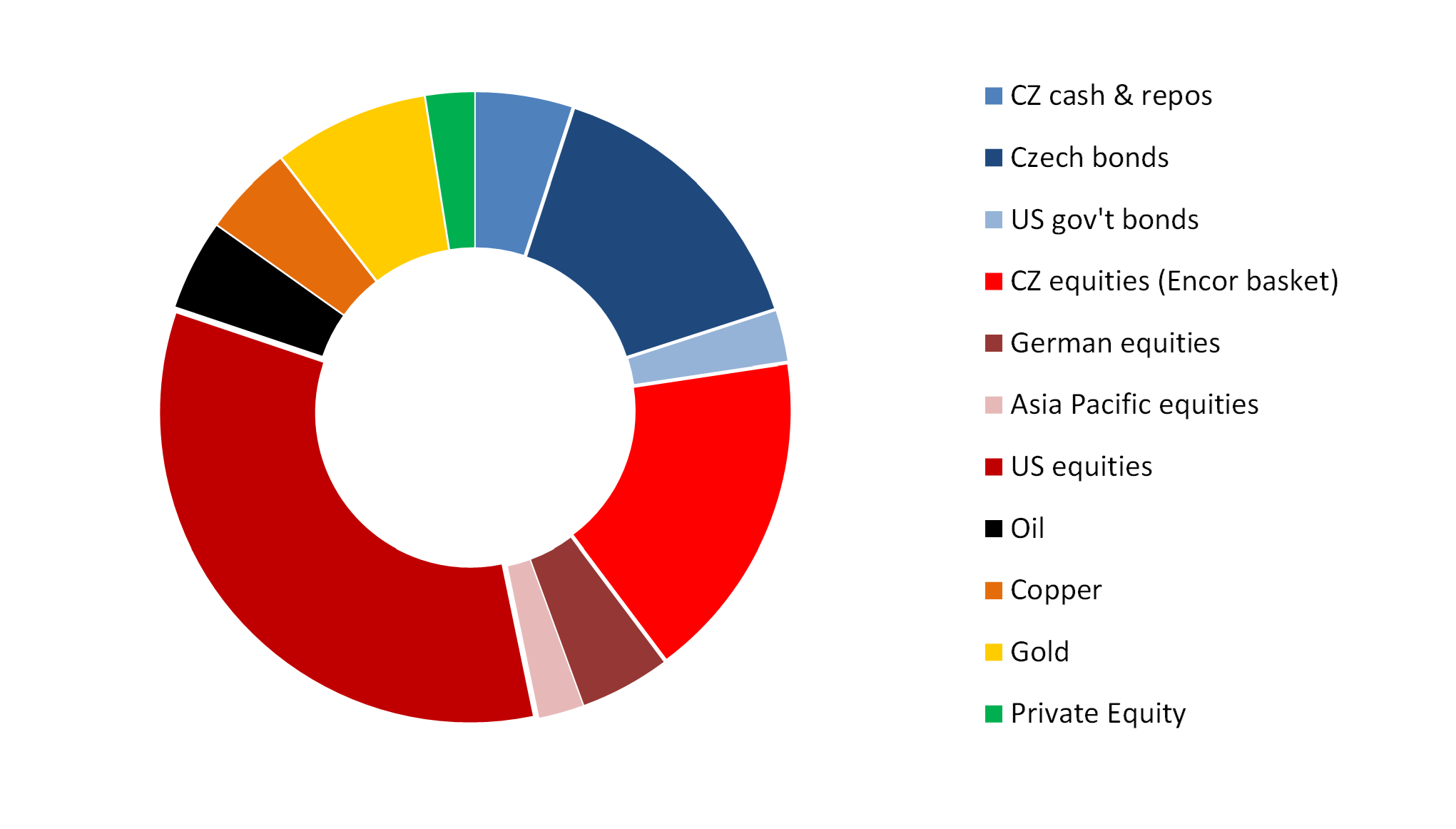
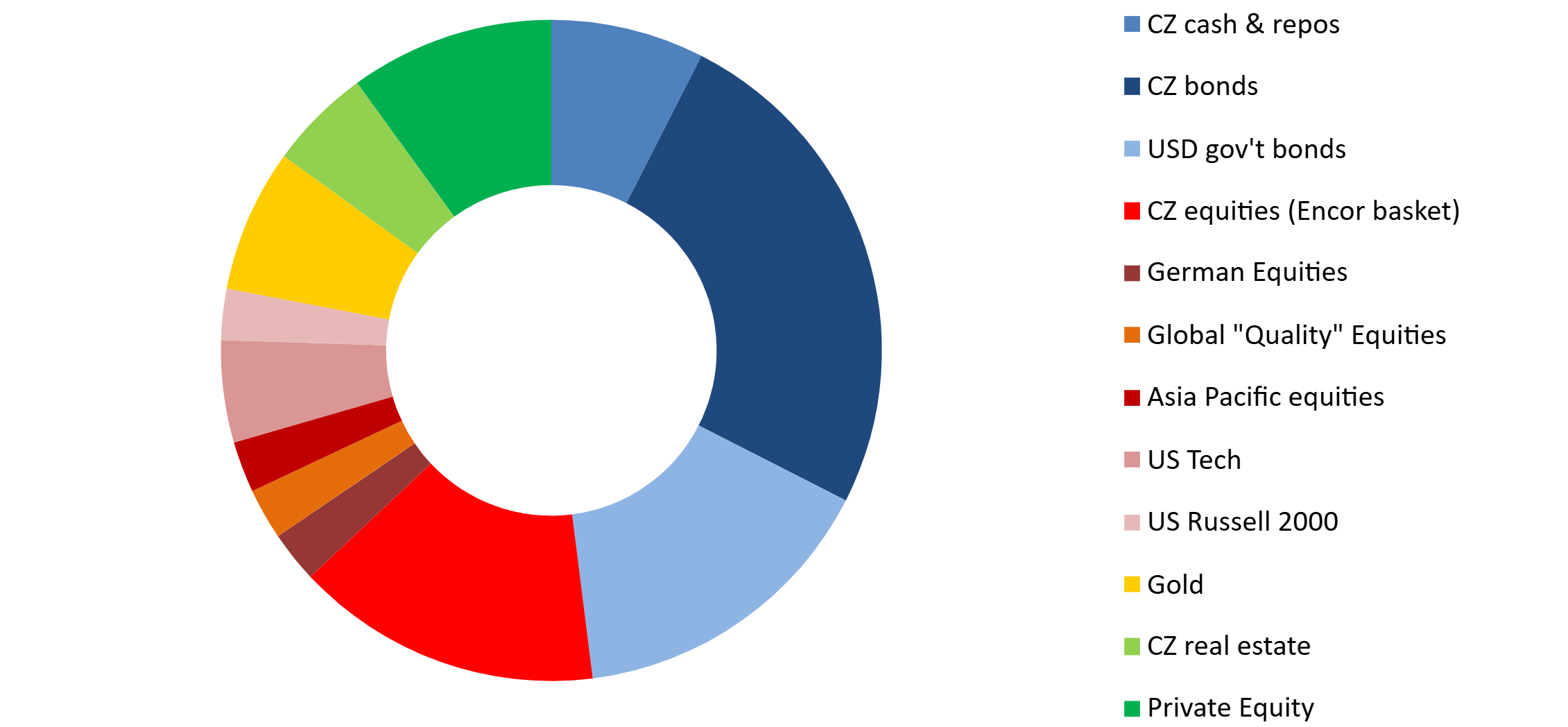
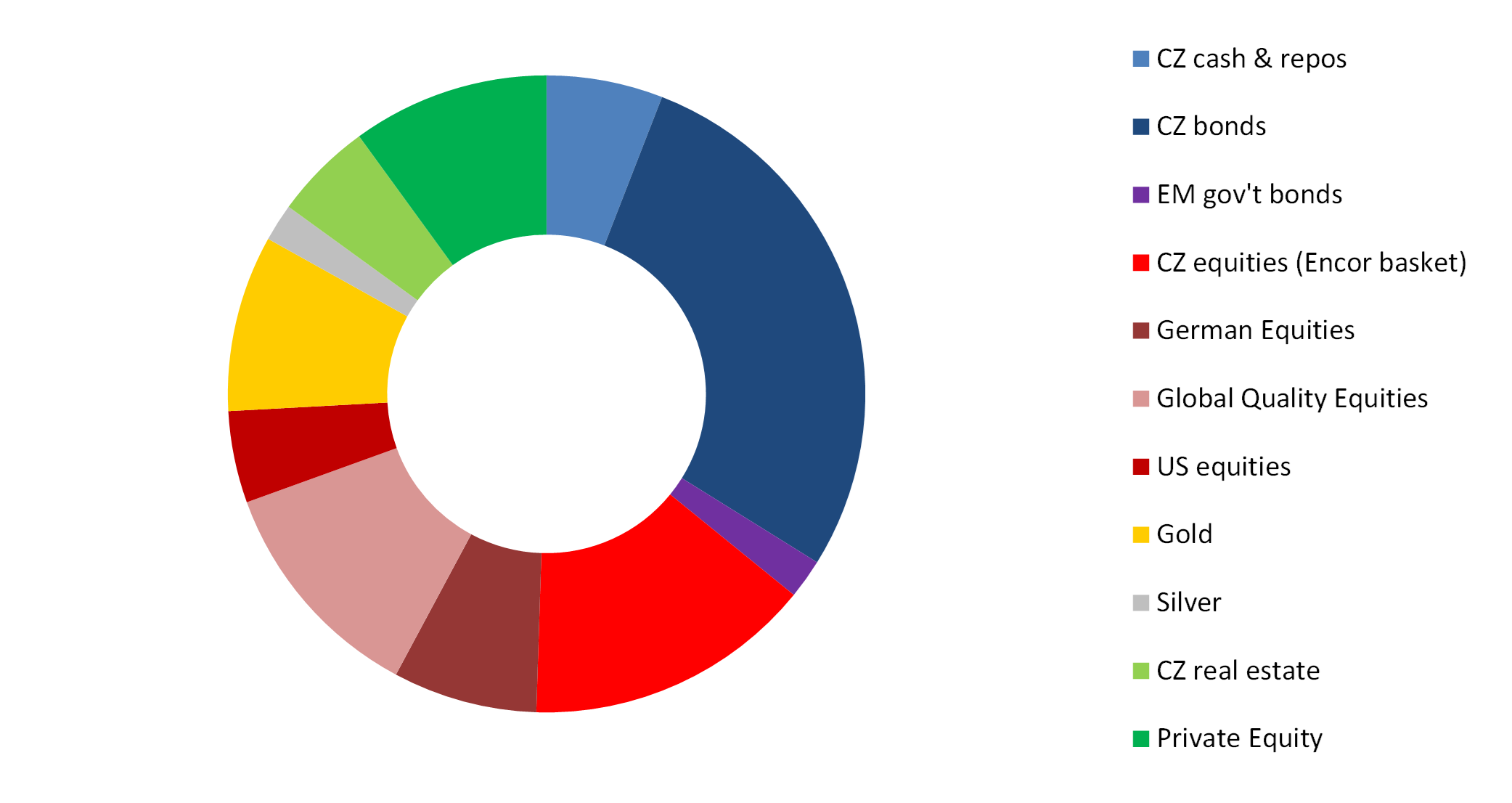
The prices of riskier assets outside of US Tech equities continued to rise in the final months of 2025 and through January 2026. The observed trends over the past 12-18 months, including a weaker dollar, interest rate cuts and continued stimulus from governments running wide fiscal deficits gave fuel to most equity markets and commodity prices to climb towards fresh all-time highs. Our proprietary EnCor asset allocation model largely maintained weights in those riskier assets for Q1 2026, while seeking to diversify within both the Equities and Commodities asset arenas.

Allocation for a typical moderate risk client into Q1 2026*
 

Source: EnCor Wealth Management proprietary asset allocation model.

See disclosures at the bottom of this text.                                             * Weights as of end January.
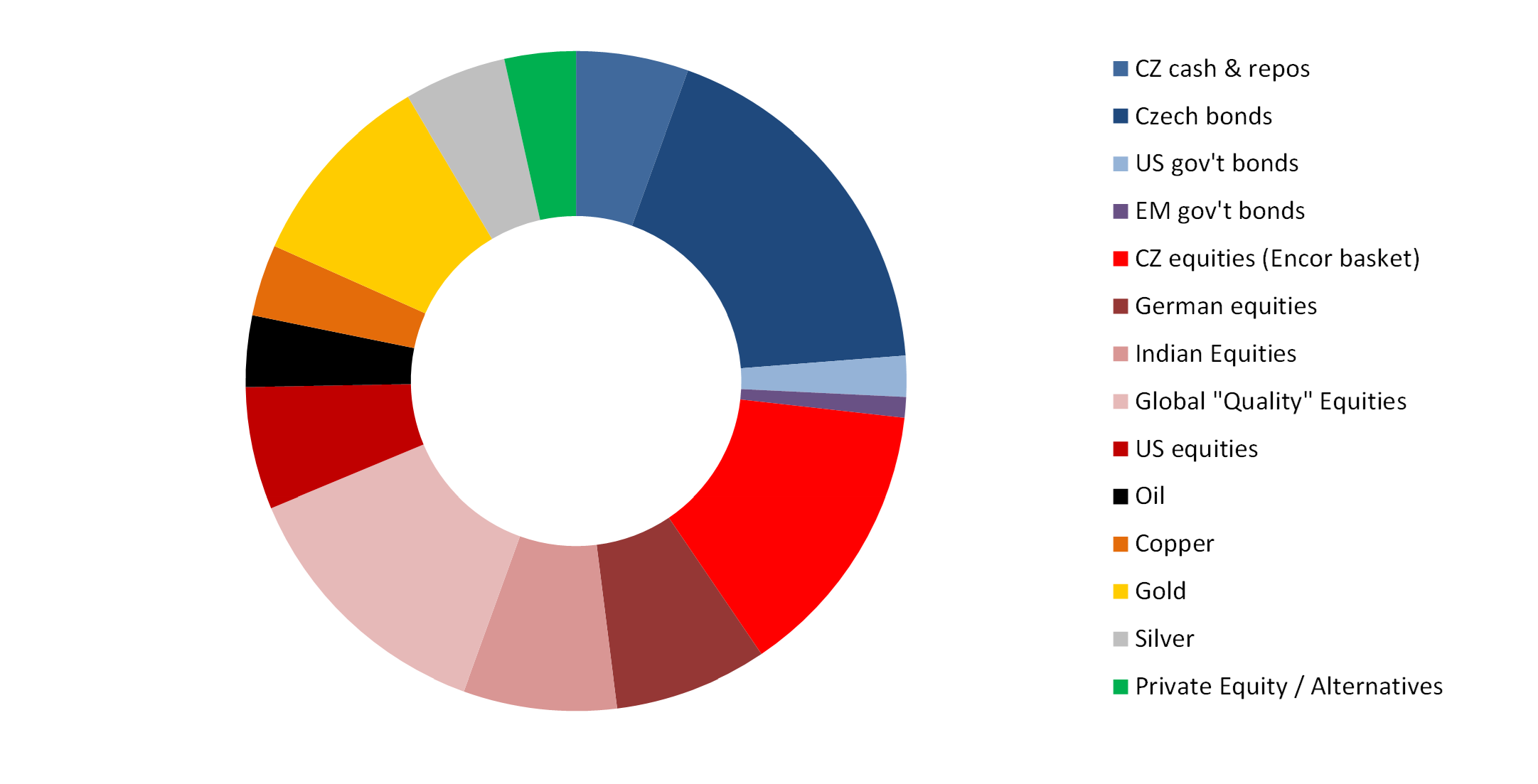
Allocation of our “Rustovy” Dynamic OPF – Q1 2026*

Source: EnCor Wealth Management proprietary asset allocation model.

See disclosures at the bottom of this text.                                             * Weights as of end January.


The Q1 update of our asset allocation model shows positive signals on economic growth in the coming year in Emerging Markets and in Asia, as well as Central Bank total asset indicators indicating that liquidity is being fed into the global economy. Some leading indicators of US economic growth are softening. Our portfolios thus diversified away from US equities for this quarter.  Valuations of US Tech and “AI” stocks remain at very high levels, while the growth dynamic in the heavyweight and heavily-owned software sector may be under threat.

In the Equities space, we took fresh positions in “Global High-Quality” ETFs, while also adding to positions in the German market. “High-Quality” companies are those with well-developed business models, generating high returns on capital employed and paying out decent levels of dividends when measured by yield. We largely maintained weights in Czech equities, which have similar characteristics to those global peers. The dividend yield of the Czech bourse still sits close to 5% even after 2025’s stellar market performance. In our higher-risk portfolios, we added fresh positions in India, the UK, European shares and Swiss Defensive stocks.

Commodities were among the strongest performers among asset classes in the last quarter and this has continued so far in 2026. Precious metals saw continued buying from financial investors, Central Banks (in the case of gold) and industrial players (in the case of silver). Prices of both of these stores of value saw significant volatility at the end of January, as physical shortages started to affect investor positioning and sentiment in the paper proxy markets. Oil prices rose in reaction to geopolitical events, including the forced reduction of supply from Russia while relative supply scarcity saw copper prices hit all-time highs. Our higher-risk portfolios now hold positions in all four of these key commodities.

What these equity and commodity asset classes have in common is that they tend to out-perform when the US dollar is weakening. Our asset allocation model has clearly positioned for further moderate slippage in the value of the “greenback” versus both major peers and real assets (such as the precious metals). Why might the dollar slip further? The probability of more international policy “flip-flops” to-and-from extreme positions by President Trump is a risk factor in itself. This is also “encouraging” the ongoing slow reduction of the dollar as the chief global reserve currency. The US fiscal deficit looks to be sustaining at a very wide level, something that currency markets usually fear. And for good reason, because the likely “solution” to funding that deficit is for interest rate cuts to be executed and “money-printing” or Quantitative Easing being applied in size. Which means more dollars in circulation and if there is more of something, its value should fall. And, as mentioned, some leading indicators of growth in the US are softening. As a result our US equity exposure is pared down. And we own almost no US government bonds in our portfolios, preferring mainly Czech Koruna fixed-income exposures.

Our asset allocation for Q1, with large weights in commodities and non-US equities, reflects the probability of accelerating global liquidity, a weaker US dollar and a recovery in international growth. These asset classes may be “under-owned”, compared to US assets, by investors. Our portfolio positions in Czech cash, Czech corporate bonds and gold, as before, provide diversification and stabilising characteristics for our clients in what remains a volatile geopolitical and valuation environment.

Disclaimer: This article does not constitute an investment advice, or a recommendation to buy or sell a specific security. Please contact us at welcome@encorwealth.com if you would like to consult on your individual situation.

Author:  Mark Robinson (10 February 2026)
EnCor Navigator: allocation of assets in Q4 2025

Pump-primed world economy

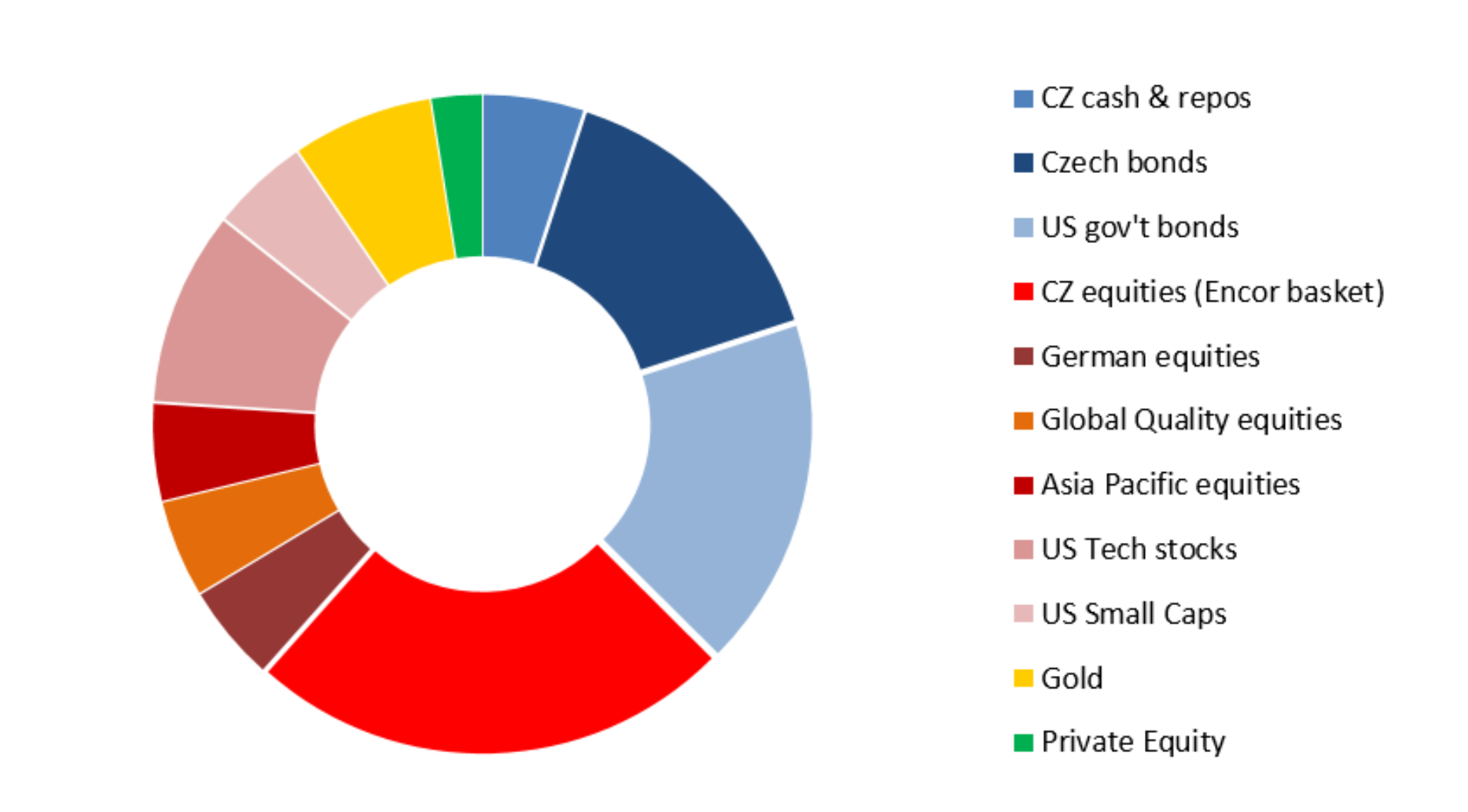
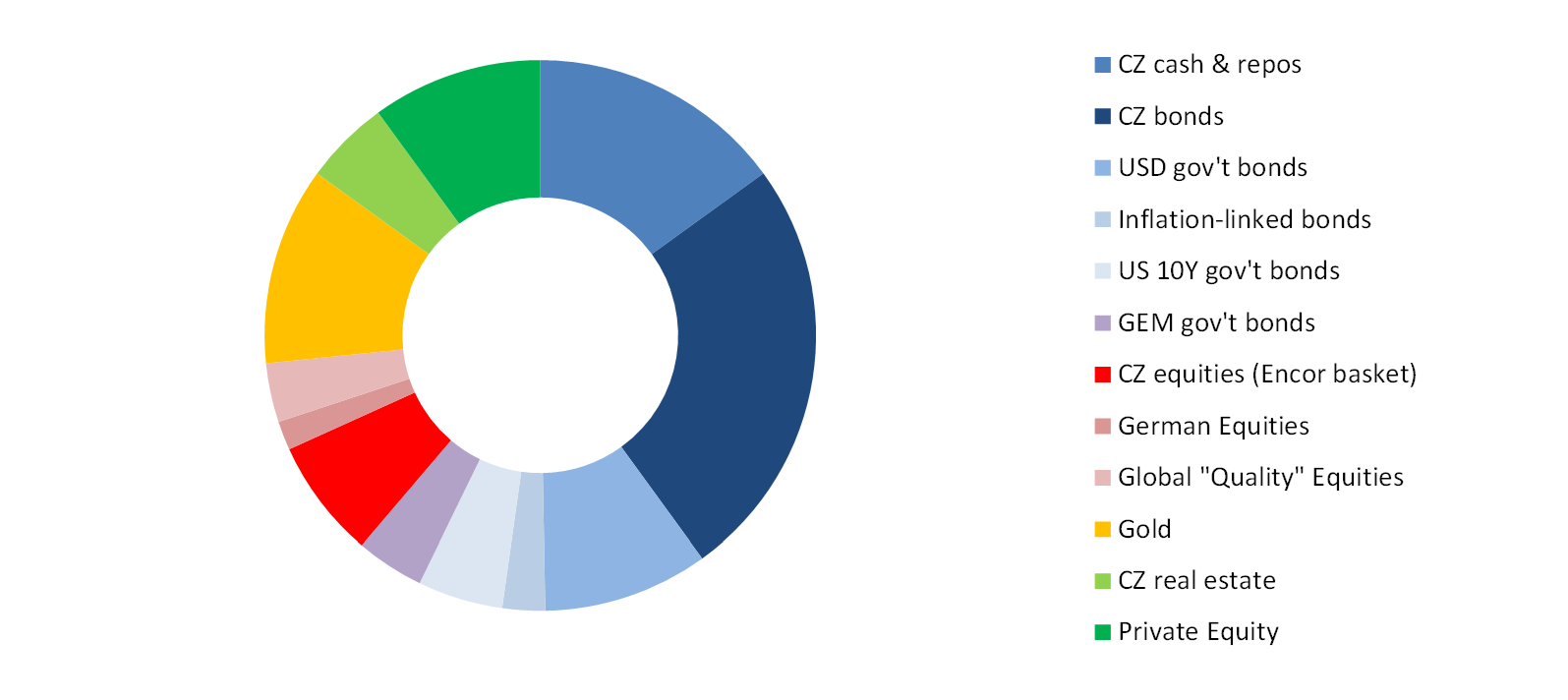
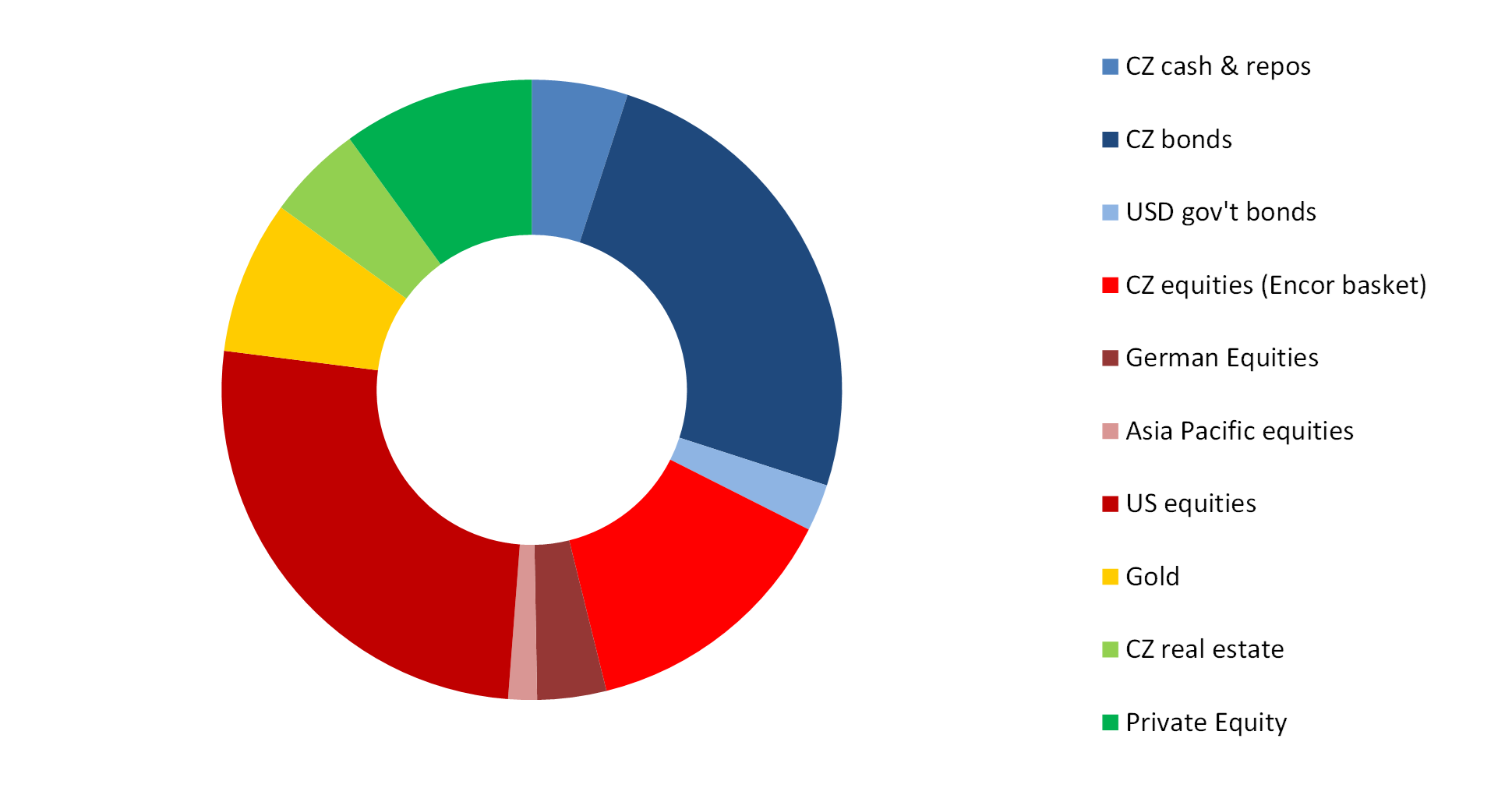
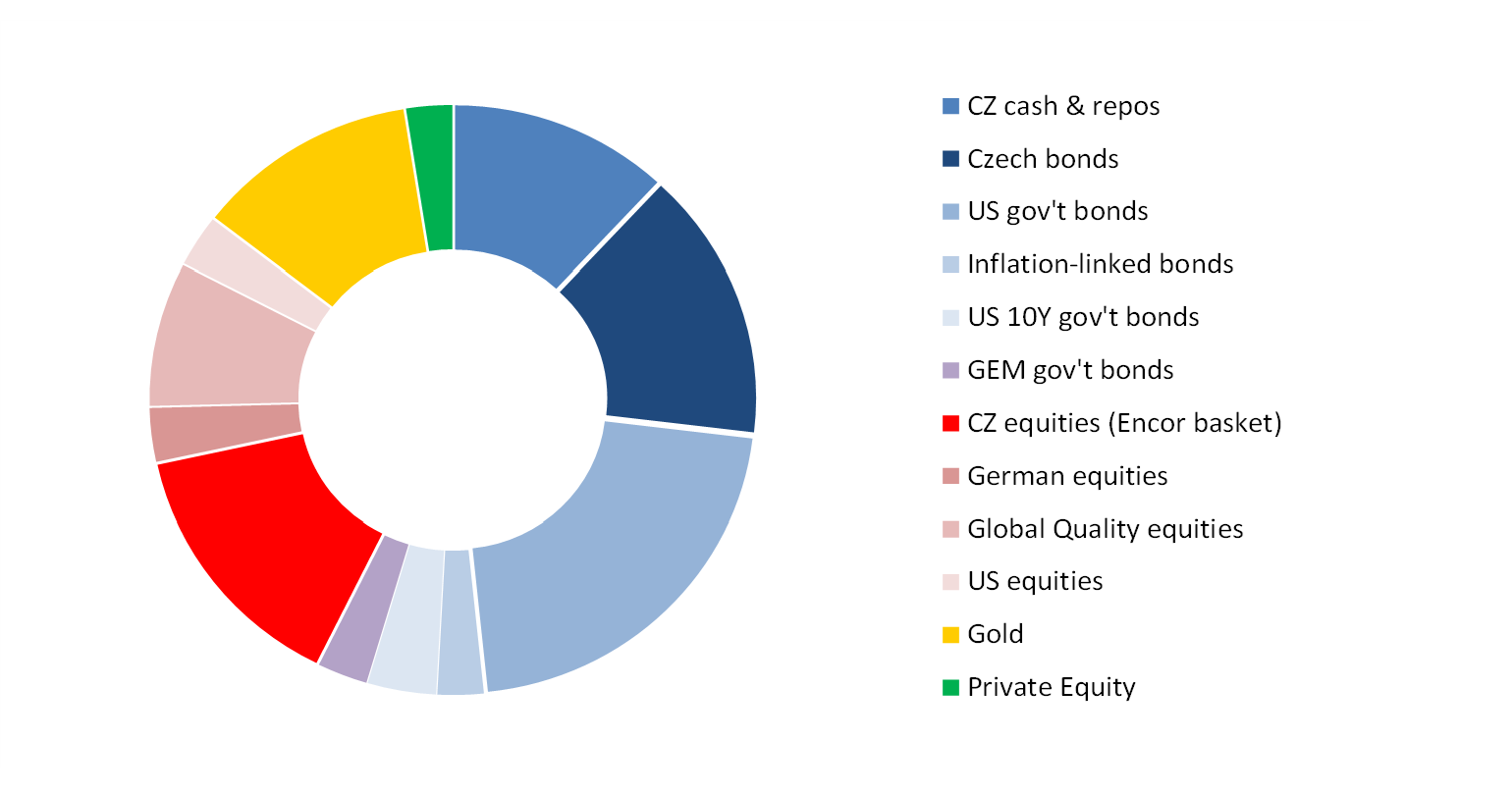
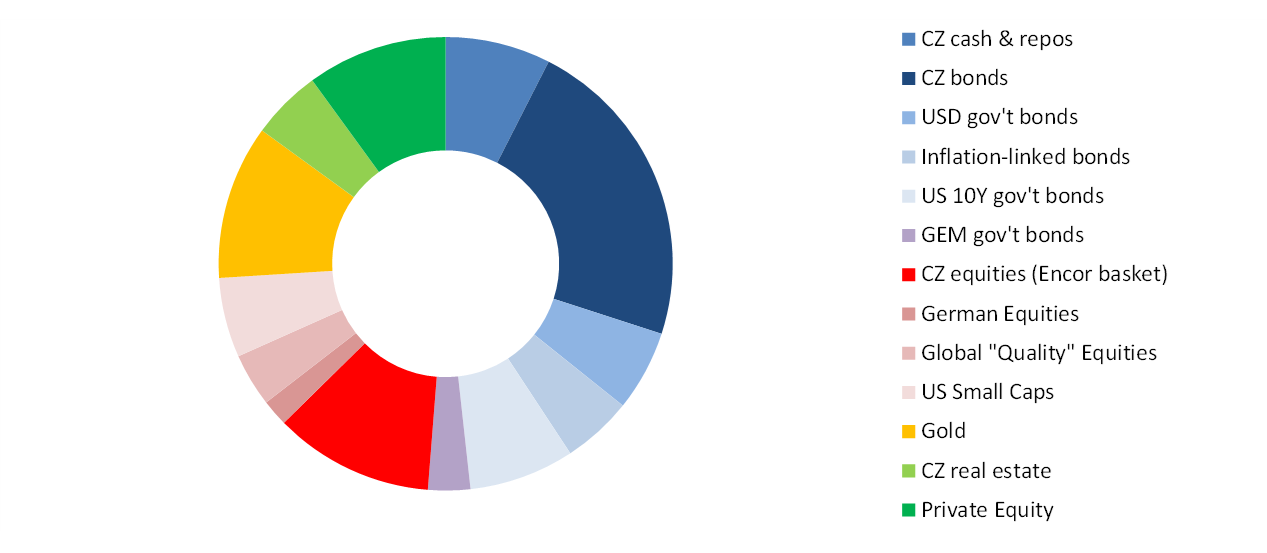
The recovery of risky assets from April’s severe drawdown has sent several equity markets around the world and the precious metals to continued record highs over the summer and autumn period. A fuller understanding of US tariff policy has seen the US Dollar stablise after its draw-down in the first half of the year. That weaker dollar, interest rate cuts over the last 18 months and continued stimulus from governments running wide fiscal deficits have set the conditions for further rallies in riskier assets. Our proprietary EnCor asset allocation model increased weights in those riskier assets for Q4 2025, again trimming down weights in US government bonds.

Allocation for a typical moderate risk client into Q4 2025*

Source: EnCor Wealth Management proprietary asset allocation model.
See disclosures at the bottom of this text.                                             * Weights as of end October.

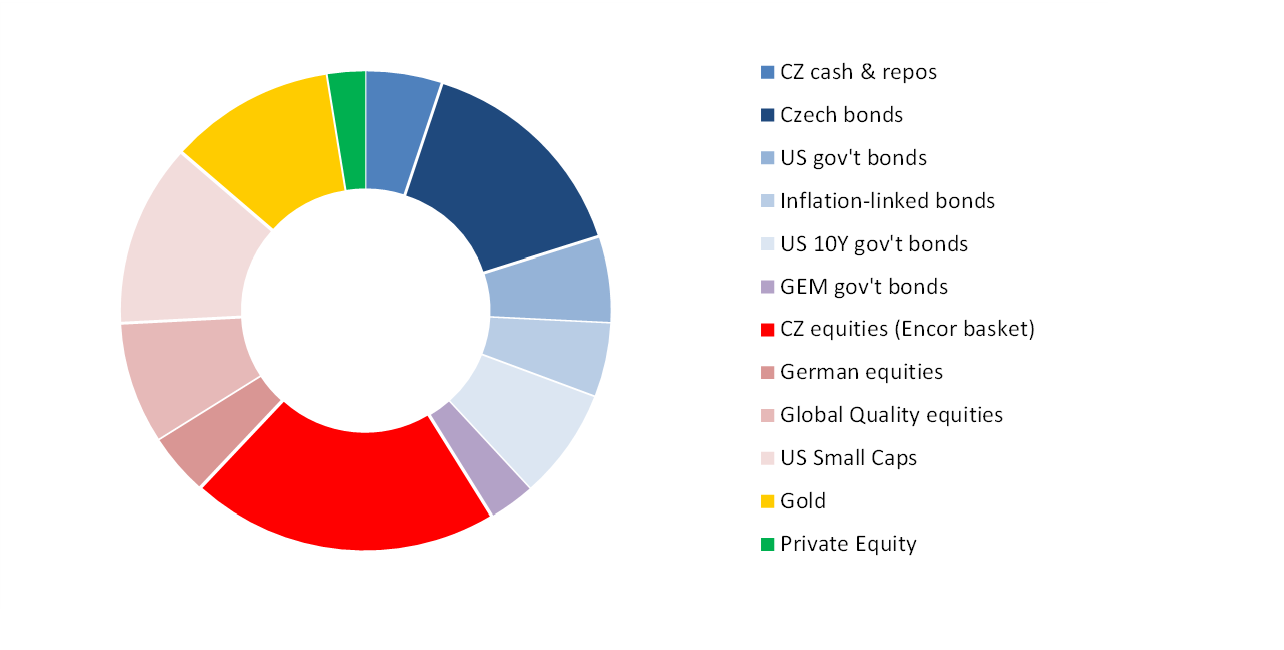
Allocation of our “Rustovy” Dynamic OPF – Q4 2025*

Source: EnCor Wealth Management proprietary asset allocation model.
See disclosures at the bottom of this text.                                             * Weights as of end October.


The Q4 update of our asset allocation model shows positive signals on economic growth in the coming year in various geographies, as well as Central Bank liquidity indicators stabilizing. Rallies in the Australian dollar versus USD and the USD versus the Japanese Yen point also to improving market sentiment. As well as the rotation from equities to bonds, our higher-risk mandates including the EnCor “Rustovy” Dynamic OPF see fresh weightings in cyclical commodities oil and copper. These are high-conviction positions that have not featured since summer 2024 in the case of copper and mid-2022 for oil.

The other major rotation in our portfolios this quarter is towards US equities, largely out of other equity classes. US bourses make up the bulk (well over 60%) of global equity market capitalization and will be at least this proportion of our overall exposure to stock markets for this quarter. US company earnings are growing at a healthy 13% year-on-year rate, according to data provider FactSet, while the latest estimate for third quarter GDP growth from the Atlanta Fed’s GDPnow model is 4.2% year-over-year. This is a very solid earnings base for the stock market. It remains to be seen how the US government shutdown, now ended, will affect fourth-quarter output. Most economic activity in America is outside of the government sphere.

Our model signals for Q4 to reduce more defensive, higher dividend-paying Czech and global “high-quality” companies in favour of the US. In addition, we remove the out-performing positions in the US Tech (due partly to the AI theme) and US Small Cap arenas, in favour of a “plain vanilla” diversified exposure to the US S&P 500 Index. There is ample profit to be taking also in the case of the Czech market. So far in 2025, the Czech index has rallied an impressive 50%, including dividends while the total return of US equities is in fact flat overall in CZK terms this year: the strength of the Koruna versus the USD has wiped out the 14% local-terms rally in the key US bourse.


Worries over the US government shutdown and the future path in general of fiscal policy in the world’s largest economy and elsewhere, including China and France, has contributed to the very strong rally in precious metals seen in Q3 (and before). Our portfolios retain their holdings in gold for this coming quarter. There remains little sign that governments are going to rein in their spending, thus implying that Central Banks will have to accommodate increased money supply and retail investors deal with inflation: this pushes up the nominal price of precious metals denominated in fiat currencies (most obviously in US Dollars). Many Central Banks around the world remain determined to continue the medium-term build-up of their gold reserves, again wanting to diversify away from holdings of G10 fiat currencies, including the weaker Dollar.

Our asset allocation for Q4, with large weights in equities and fresh positions in cyclical commodities, reflects the probability of an accelerating global economy. Investors have moved beyond the impact of H1 2025’s US tariffs and see the resulting weaker US dollar as providing some liquidity for markets and greater scope for international economic activity.  Our portfolio positions in Czech cash, Czech corporate bonds and gold, as before, provide diversification and stabilising characteristics for our clients in this environment.

Disclaimer: This article does not constitute an investment advice, or a recommendation to buy or sell a specific security. Please contact us at welcome@encorwealth.com if you would like to consult on your individual situation.

Author:  Mark Robinson

EnCor Navigator: allocation of assets in Q3 2025

The new show in town

The stabilization of global asset markets over the last quarter signals the beginning of investors understanding the new macroeconomic rules and conditions for interacting with the world’s largest economy, the US. Several globally-significant equity markets hit fresh all-time highs in local currency terms, though adverse foreign exchange movements pared down gains significantly for Koruna-terms investors. Our proprietary EnCor asset allocation model absorbed the signals of this stabilization, raising weighings of equities for Q3 towards neutral, trimming down weightings in bonds and cash. The “new show” that is the Trump Administration targets both strong GDP growth and a rebalancing of the US economy. For now, markets believe that both aims are mutally plausible.


Allocation for a typical moderate risk client into Q3 2025*


Source: EnCor Wealth Management proprietary asset allocation model.

See disclosures at the bottom of this text.                                             * Weights as of end July.

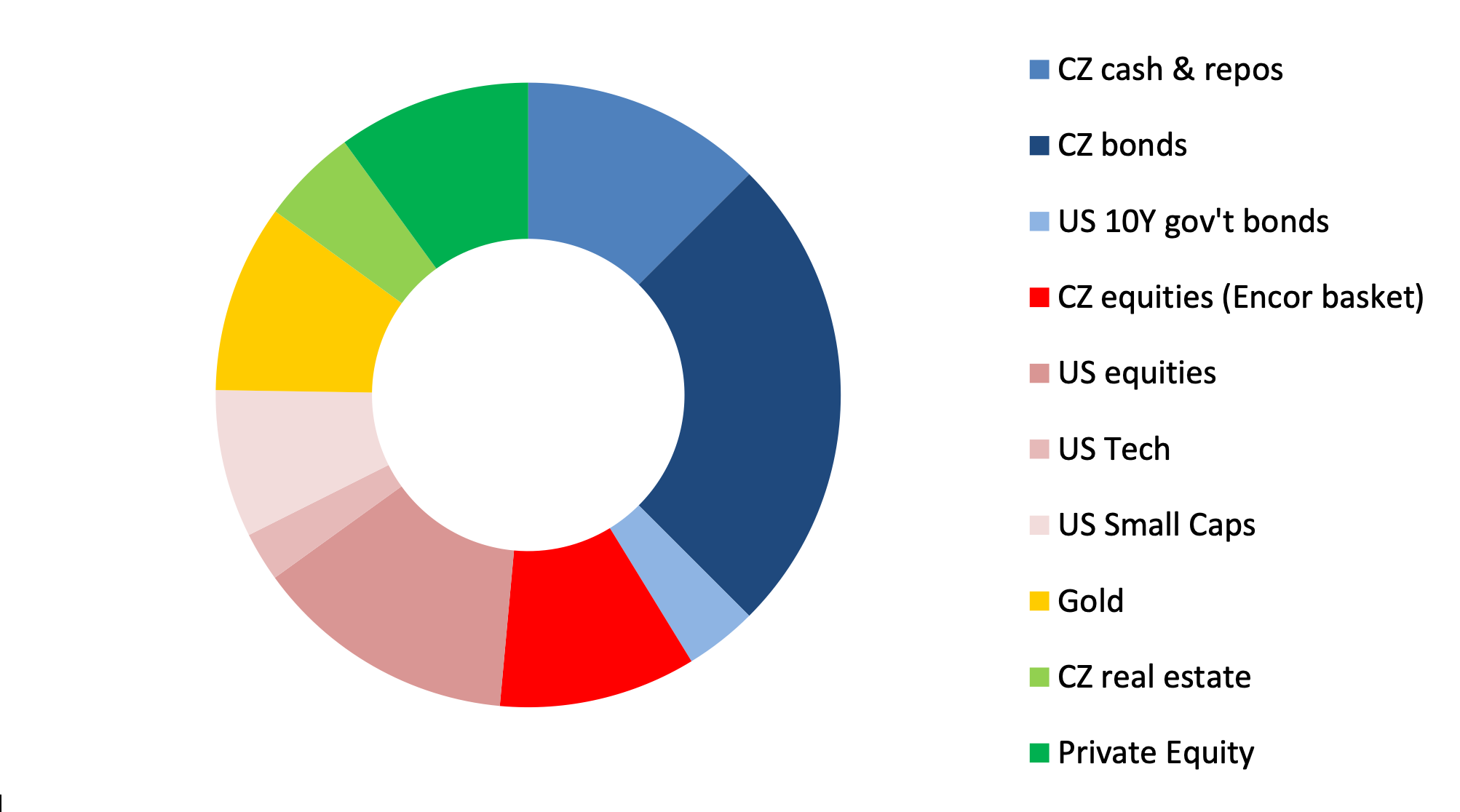
Allocation of our “Rustovy” Dynamic OPF – Q3 2025*

Source: EnCor Wealth Management proprietary asset allocation model.
See disclosures at the bottom of this text.                                             * Weights as of end July.


Liquidity, credit sentiment and growth signals from the Q3 update of our model indicated an improvement from the troubled first three months of the new Trump Administration. As a result, we added significantly to our positions in equities. Around half or more of our exposure to the asset class, depending on the mandate, is in Czech shares. Our portfolios have already benefited in 2025 from the 27% koruna-terms return (excluding dividends) of the Czech PX Index to the end of July. A recovering Czech economy and healthy prospects for local corporate profits and ongoing payouts to shareholders are both underpinning market sentiment. Investors await October’s parliamentary elections and a possible reduction of geopolitical risk if peace indeed comes to Ukraine. Our portfolios additionally retain their positions in German (up 18% year-to-date in CZK terms) and European markets (up 6%).

US shares, despite also hitting fresh all-time highs for US dollar investors, were still actually -5% down in Koruna terms during calendar 2025 at the end of July. Our model takes advantage, increasing weights to the world’s largest equity market for this quarter. The dollar has lost nearly 12% of its value versus the Koruna this year, depressing returns for all USD-denominated bond asset classes as well. This weakness of the “greenback” means that, presently, it is currency markets that have priced in the economic effect of higher US tariffs on imported goods. The Trump Administration has negotiated or set “permanent” tariff levels for almost all trading partners, with the notable exception of China. And the weaker dollar makes imports more expensive for US consumers by itself, helping to reduce the trade imbalance. The passing by Congress of Trump’s signature fiscal package, the “Big Beautiful Bill” at the beginning of July buoyed risky asset sentiment, as it primes US GDP growth by extending major tax cuts. At the same time, the Bill’s provisions are set to increase the country’s huge government budget deficit yet further.

Thus, the Trump Administration seeks to shrink the US’s trade imbalance but is doing almost nothing about the fiscal deficit, aside from the marginal but massively-publicised “DOGE” initiatives. Holders of US government bonds (and Elon Musk himself) are rightly questioning this situation and are doubting, absent a change of policy-making at the presently-independent US Federal Reserve, that measures of “core” inflation will allow for policy interest rate cuts. Our model signals to hold only very short-maturity US fixed income exposures in the near run, while retaining our hefty positions in Czech corporate bonds.

Overall, our asset allocation for Q3 remains on the cautious side of neutral. Markets are still assessing the techniques and moves of the Trump Administration, the new show in town. The tariff uncertainty has, for now, settled down. But inflation uncertainty has not gone away and a higher “cost of capital” for companies and investors globally looks like a fair assumption to make when pricing in future macro developments. Our portfolios retain a position in gold, which often acts as an insurance policy in such situations. The (reality) show must go on.

Disclaimer: This article does not constitute an investment advice, or a recommendation to buy or sell a specific security. Please contact us at welcome@encorwealth.com if you would like to consult on your individual situation.

Author:  Mark Robinson

EnCor Navigator: allocation of assets in Q2 2025

Disruption ongoing

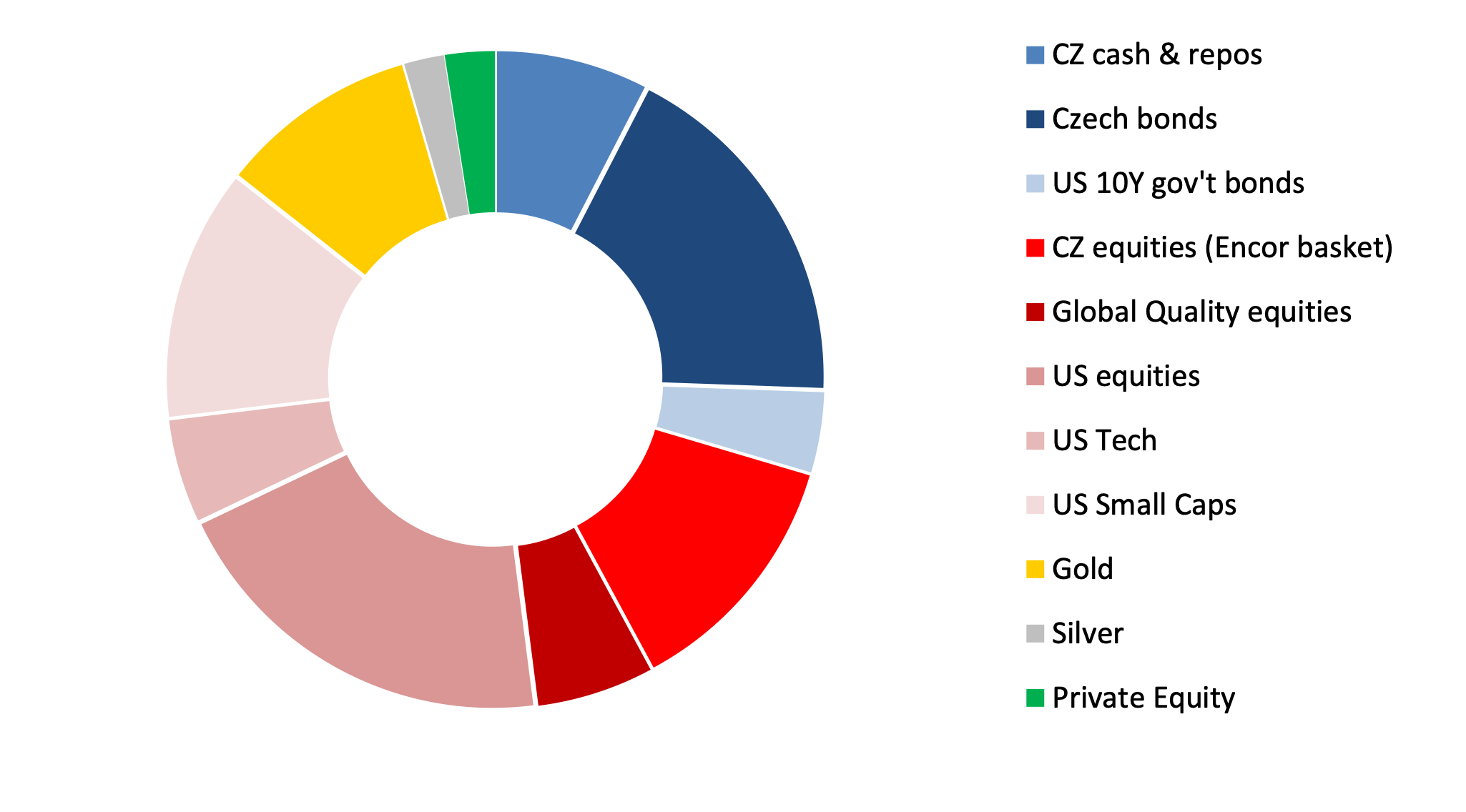
Our step to de-risk our portfolios at the end of January proved prescient, as US assets, especially equities, sold off through most of the last 3 months. The signal for Q2 from our proprietary asset allocation model doubled down on our cautious positioning, reducing equities further and raising cash and very short-term bond positions. The first 100 days or so of the second-term Trump Presidency has posed both structural and cyclical challenges for investors. Asset markets are likely to consolidate at best for the remainder of Q2, while remaining vulnerable to renewed downside momentum if unexpected policy shifts occur, liquidity conditions worsen or key macroeconomic data deteriorate.

Allocation for a typical moderate risk client into Q2 2025*

Source: EnCor Wealth Management proprietary asset allocation model.
See disclosures at the bottom of this text.                                             * Weights as of end April.


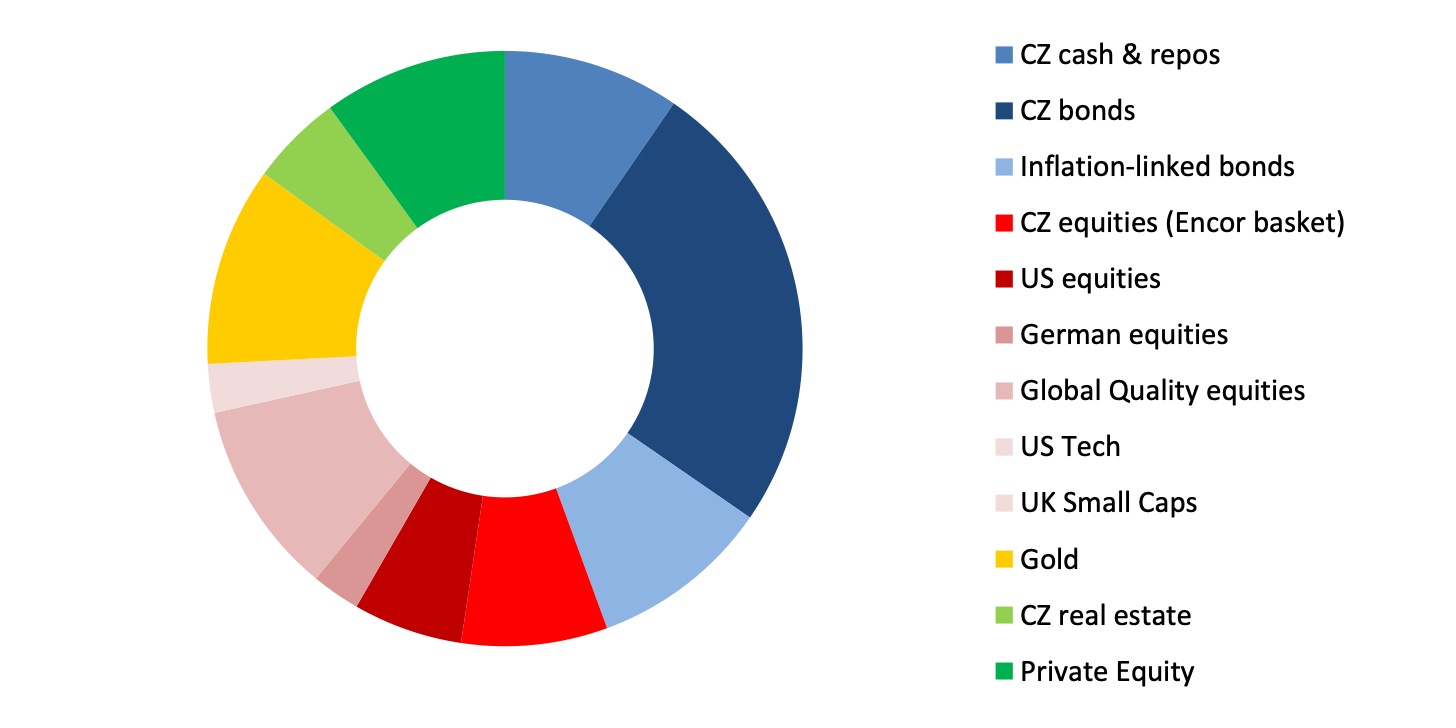
Allocation of our “Rustovy” Dynamic OPF – Q2 2025*

Source: EnCor Wealth Management proprietary asset allocation model.
See disclosures at the bottom of this text.                                             * Weights as of end April.


Liquidity, sentiment and growth signals from the Q2 update of our model show a clear deterioration already over the past 3 months. For Q2, we removed around a third of our positions in equities in our mandates and funds, selling most of our rump US positions and taking profit from Czech shares. We raised cash weights, held both in Koruna and in very short-term (maximum 6-month maturity) US Treasury Bills. Risky asset markets sold off heavily in March and the first half of April, as investors realized the intent of the Trump Administration to rebalance the US economy. This process involves reducing American consumption of imports, thereby shrinking the trade deficit at the same time as cutting government spending, which was (partially) feeding that consumption. If the US government follows through fully with this rebalancing, the global economy will face profound changes.

But for the moment, the Trump Administration has “blinked”. They have backed down, for now, on the more extreme impositions of tariffs announced on the President’s “Liberation Day” (2 April). Equity markets have recovered since their lows in the middle of April, with government bond and currency markets stabilizing. The rally in risky assets has taken some European bourses, including Germany’s DAX Index and the Czech PX-TR, to fresh all-time highs at the time of writing in the middle of May. US shares have largely made up their USD-terms losses year-to-date. But longer-dated US Treasury bonds (-5% in CZK terms) and equities (-9%) are still down year-to-date in 2025 due to the substantial fall in the US dollar versus the Euro and Koruna. Currency markets are already pricing in tariff disruptions.

Markets tend to discount ahead of events actually happening and it is true that a cheaper dollar does some of the job of rebalancing the US trade deficit, making exports cheaper and imports more expensive. President Trump touts the inward investment deals he has agreed with Middle Eastern partners and some US and global corporates as evidence that the economy can be renewed and rebalanced. Yes, it can but it will take 2-10 years to execute. 10% import tariffs look like the minimum levels to be imposed for the medium term. “Permanent tariff deals” remain to be struck with many major partners, apparently all before mid-July. In the meantime, making imports more expensive and removing “stimulating” government spending is likely to curb US consumption and/or reduce the profits of US companies in the import-consumption chain. So, an economic and/or an earnings growth slowdown looks very likely. Perhaps also accompanied by inflation of US consumption goods prices, which might be counterbalanced by cheaper energy input costs.

It will take time for US and foreign companies feeding the vast US consumption machine to adjust to a changed reality. If it is indeed permanent, which we don’t know yet. For investors, this introduces profound uncertainty over the path of earnings growth for all involved companies worldwide. Uncertainty very often brings violent asset price movements, which we have seen already during 2025. When this occurs, the “required return” for investing rises, to price in uncertainty. In addition, valid concerns over the US and Japanese fiscal balances are pushing up longer-term bond yields. This mechanism also pushes up the “required return”/cost of capital for companies and consumers, which should cause high valuations (especially in US equities) to decompress. It also causes “mark-to-market” losses for longer-term bondholders and questions to be asked in credit markets where there are only low levels of risk premiums built in.

Thus, given this environment, our asset allocation for Q2 is cautious. Our portfolios retain a full position in gold, which rose 6% in CZK terms since the end of January, bolstering our clients’ performance. Most of our remaining weights in equities are in German, “high-quality” dividend-paying global companies and defensive Czech shares. Investors worldwide are likely to need a lot of convincing that President Trump has discarded his “disrupter” hat before markets truly calm down.

Disclaimer: This article does not constitute an investment advice, or a recommendation to buy or sell a specific security. Please contact us at welcome@encorwealth.com if you would like to consult on your individual situation.

Author:  Mark Robinson


EnCor Navigator: allocation of assets in Q1 2025

The US Disrupter

Our pro-US equities stance helped the performance of our portfolios through Q4 2024 and into January 2025. At this point, coincidentally just after the Inauguration of President Trump, our proprietary asset allocation model signaled some caution. We thus cut weights in US shares significantly in the last week of January, rotating both into US-denominated government bonds and into the Czech and European bourses. In doing so, we were able to book some of the gains made in equities through 2024 and diversify away some of the potential risks appearing. The first month of the second-term Trump Presidency has thrown up a lot of questions for investors, some of which may not be answered quickly or conventionally.

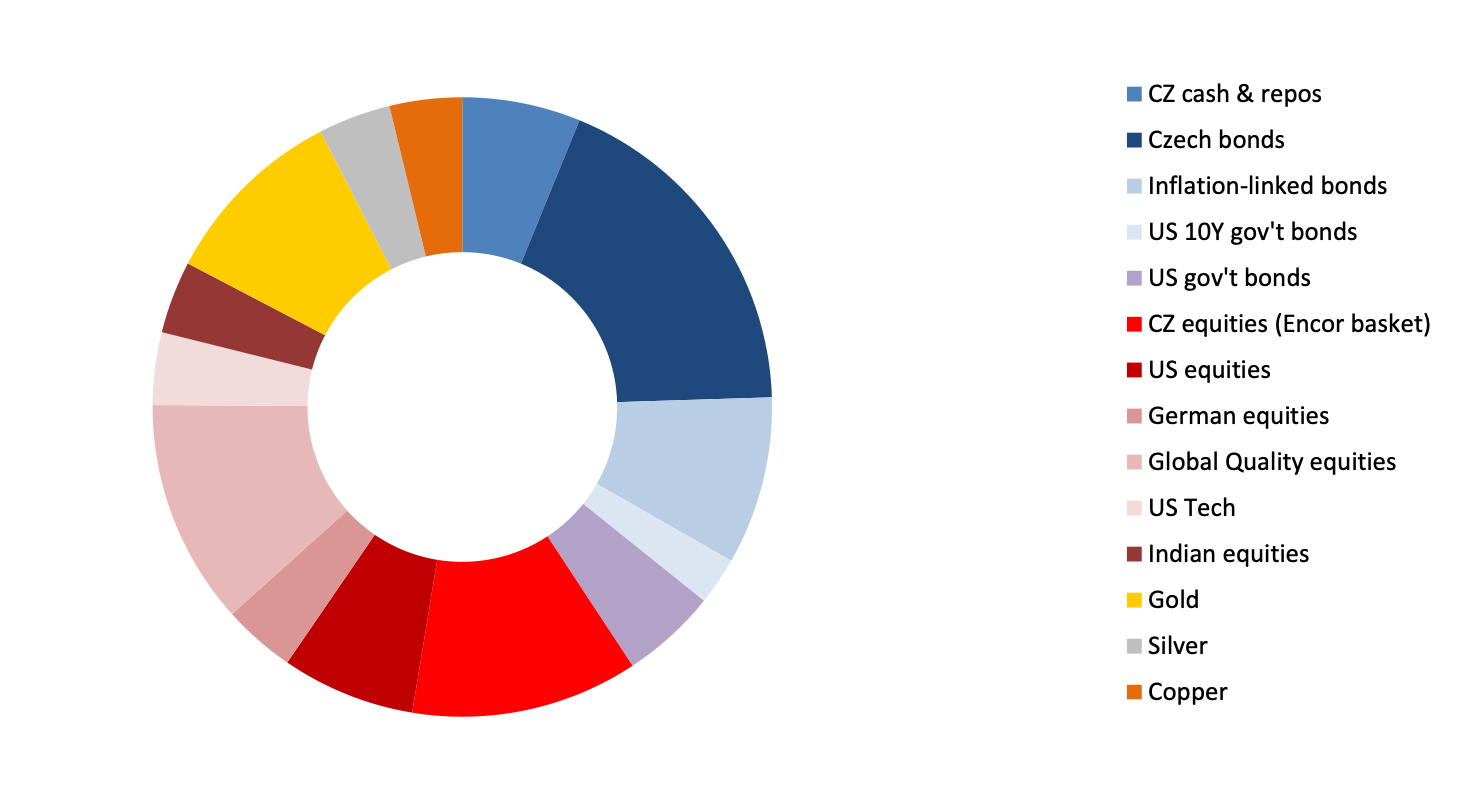
Allocation for a typical moderate risk client into Q1 2025*

Source: EnCor Wealth Management proprietary asset allocation model.
See disclosures at the bottom of this text.                                                     * Weights as of end January.

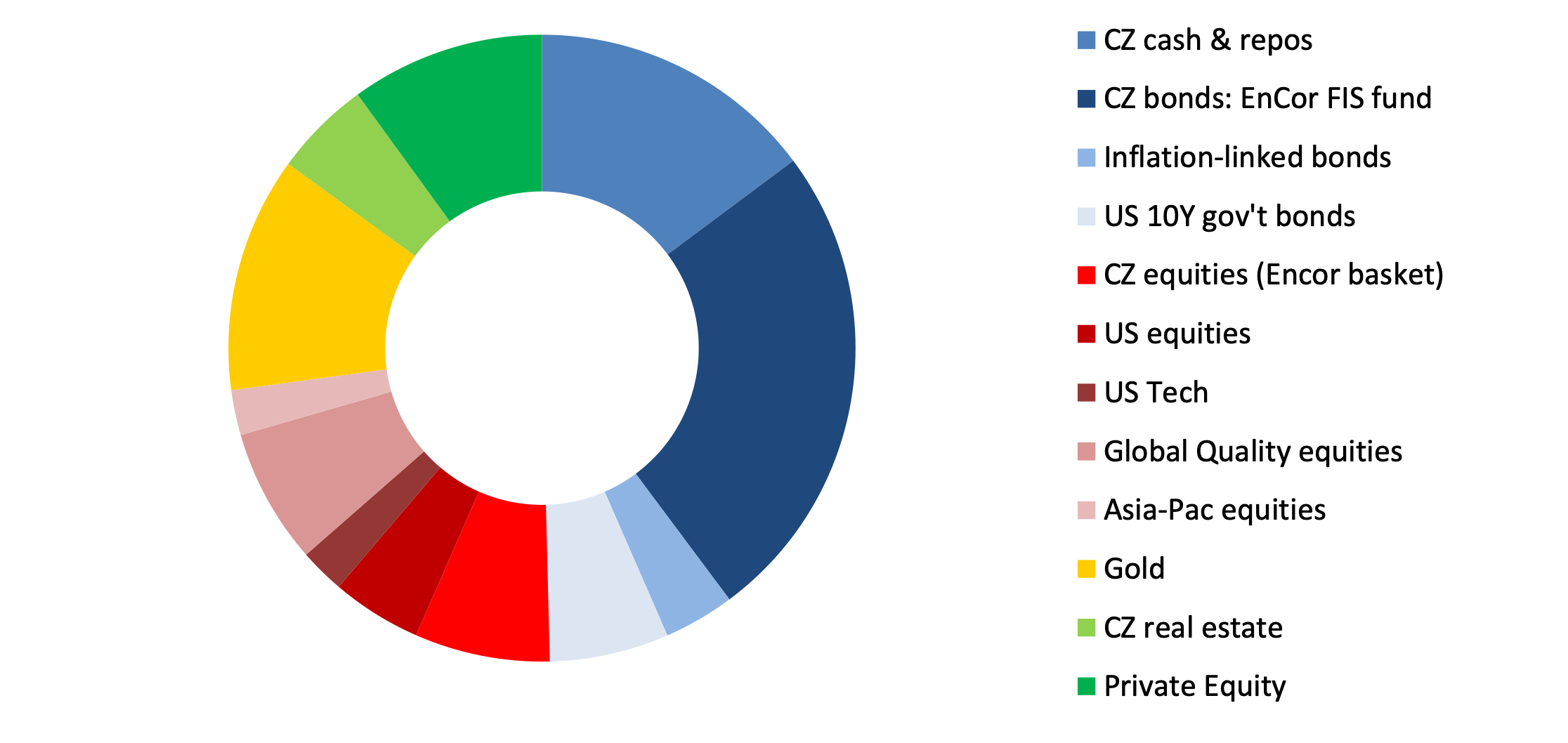
Allocation of our “Rustovy” Dynamic OPF – Q1 2025*

Source: EnCor Wealth Management proprietary asset allocation model.
See disclosures at the bottom of this text.                                                     * Weights as of end January.


Liquidity, sentiment and some growth signals from the Q1 update of our model all suggested some caution towards riskier assets. Accordingly, we removed around a quarter of our positions in equities in our mandates and funds, replacing the weightings with US-dollar denominated bonds. Some uncertainty is since starting to be priced into markets, resulting in US government bond prices rallying even in the face of stronger-than-expected inflation readings. US equities sit at very rich valuations, thus pricing in a high-growth scenario and making them somewhat vulnerable to a correction phase.

Commentators and investors face a dilemma when considering the impact of the new US Administration. On the one hand, it has demonstrated its low-tax, market-friendly credentials by asking Congress to extend the raft of personal income tax rate cuts that the first Trump Presidency famously passed in 2017. And efforts to rein in the huge US fiscal deficit via spending cuts through the instrument of Elon Musk’s Department of Government Efficiency (“DOGE”) should ultimately please bond investors. But the extent of “disruption”, not just from DOGE but the de-globalising threat (and reality in the case of China at the time of writing) of increased tariffs on the US economy may yet be under-estimated. High government spending, including on health programmes, helped the US economy to grow much faster than its peers in the past couple of years. Replacing this with private sector demand is a laudable long-term aim from a capitalist perspective but the short-term effects of this and the other mentioned moves could be weaker consumer spending, a dearth of government investment and a cautious capital expenditure (“CAPEX”) approach from the private sector. A period of “soft” GDP growth may well ensue. This, the markets may just be waking up to.

Our portfolios tilt towards Czech and European equities this quarter, with well over half of our share weights in this geography. A chance of an end to the awful Russia-Ukraine war may have bolstered sentiment but the cutting of interest rates both by the CNB and the ECB over the last 20 months has created easier financial conditions. Expectations for Czech and Eurozone GDP growth are very low and a huge potential fiscal stimulus from military spending (reaching up to 3% of EU GDP) could well act as a trigger to kick-start European economic activity via manufacturing and investment. The probability of much-increased expenditure on rearmament appears much higher after the German election results this last week.

A full, slightly larger weight in gold also bears out the more cautious positioning our portfolios have adopted for Q1. The disruptive actions of the new US Administration have thrown geopolitical, inflation and de-globalisation risks into sharper focus. In this environment, a more balanced approach is warranted, one which also includes capturing yield from dollar government bonds and from higher-quality equity ETFs and Czech shares. “Disrupters” breed disruption and market volatility.

Disclaimer: This article does not constitute an investment advice, or a recommendation to buy or sell a specific security. Please contact us at welcome@encorwealth.com if you would like to consult on your individual situation.

Author:  Mark Robinson

Nový otevřený podílový fond Global Private Credit (GPC)

EnCor spojuje síly EMUN ke spuštění nového fondu zaměřeného na rychle rostoucí globální segment private credit.

Makroekonomické změny otevírají nové investiční příležitosti, na které Emun investiční společnost reaguje spuštěním nového otevřeného podílového fondu Global Private Credit (GPC) zaměřeného na privátní dluh. Fond s počátečním kapitálem 28 milionů dolarů (650 milionů korun) od klientů a akcionářů mateřské společnosti EMUN family office, cílí na zajištěné korporátní úvěry v Americe a západní Evropě. Klíčovou kapitálovou podporu na rozjezd fondu poskytl kotevní institucionální investor EnCor Asset Management, investiční společnost, a.s.. Ambicí fondu GPC je spravovat nejméně 50 milionů dolarů a přivítat další externí investory.

Nový fond GPC kombinuje aktiva zaměřená na střední a velké společnosti působící na rozvinutých trzích v Americe a západní Evropě. Hlavní předností fondu je jeho strategie, která zohledňuje současné makroekonomické prostředí a umožňuje odolnost vůči tržním výkyvům. Tato investiční příležitost je určena pro kvalifikované české investory, kteří hledají globální expozici v oblasti private credit. Fond navíc zajišťuje měnové riziko, což poskytuje větší stabilitu pro lokální investory. Díky semilikvidní struktuře přináší flexibilitu, která je na českém trhu alternativních investic zatím vzácná.

„Historicky se jedná o poměrně bezpečnou třídu aktiv. V posledních dvaceti letech se míra defaultů pohybovala v průměru mezi dvěma a čtyřmi procenty ročně. U případě největších blue-chip globálních fondů, se kterými investujeme, je to dokonce hluboko pod jedno procento v průměru za rok. Portfolio fondu budeme takticky doplňovat o další příležitosti, které v minulosti fungovaly proticyklicky a které vykazovaly nadprůměrné výsledky v periodách volatility,“ vysvětluje Vojtěch Železný, portfolio manažer dluhových strategií.

Strategie fondu je navržena s ohledem na očekávaný ekonomický vývoj v příštích letech, kdy se předpokládá nízký ekonomický růst, vyšší inflace a vyšší úrokové sazby. Tyto faktory vytvářejí ideální podmínky pro optimalizaci výnosů právě v segmentu zajištěných úvěrů. „Právě prostředí s takovými charakteristikami považujeme za náš základní scénář pro nadcházející roky. Privátní dluh vnímáme zejména jako zajímavý doplněk dluhopisových portfolií. Důvodem jsou atraktivnější kreditní marže v porovnání s veřejně obchodovanými dluhopisy, kde se marže aktuálně pohybují blízko historických minim,“ popisuje Leoš Jirman, partner a CIO společnosti EMUN, který už více než třicet let působí na kapitálových trzích.

Lubor Žalman, partner EnCor Wealth Management (a dříve generální ředitel Raiffeisenbank) k tomu dodává: „Po bankovní krizi v roce 2008 byly banky regulátory potrestány tím, že jim stále více a více omezují pole působnosti. Tím se ale otevírá prostor pro globální fondy, které poskytují firmám nebankovní financování. Je logické tuto finanční inovaci nyní zpřístupnit i českým investorům.“

Spuštění tohoto fondu představuje pro EMUN další krok v rozšiřování portfolia alternativních investic. Tento krok následuje mimo jiné po spuštění otevřeného podílového fondu EMUN Semi-liquid Global Private Equity (GPE), který  je zaměřený na globální private equity. Fond GPE zpřístupňuje českým investorům prestižní světové asset manažery a exkluzivní investiční příležitosti mimo veřejně obchodované trhy. Nový fond tak dále posiluje pozici EMUN jako inovátora v oblasti alternativního investování.

„Tento úspěch chceme nyní zopakovat také u našeho nového fondu GPC. Dynamický růst fondu GPE a zapojení investorů včetně privátních bank v čele s Erste Private Banking jasně ukazuje zájem o globální privátní trhy. Privátní dluh je aktuálně celosvětově nejrychleji rostoucím segmentem v oblasti privátních trhů. Partnerství s velkými institucionálními investory jako EnCor nám navíc dává perfektní příležitost dosáhnout vyšších objemů nutných pro investování s globální špičkou,“ říká Filip Savi, partner a portfolio manažer v EMUN zodpovědný za investice na privátních trzích.

EnCor Navigator: allocation of assets in Q4 2024

Trump redux – 9 November 2024

One of the busiest weeks for markets in recent memory has just closed. Interest rate cuts by 3 Central Banks, including the US Fed and the CNB, accompanied Beijing’s announcement of large financial support for China’s regional governments and news of the likely fall of the German government with elections probable within months. But it was the return of Donald Trump to the White House, along with an almost-certain Republican “Red sweep” of both Houses of the US Congress that gripped the imagination of markets. The former President defied conventional polling (again), to easily secure a second term in office. US equity investors cheered, sending the market to another all-time high, commodity markets paused for thought, while US bonds sold off.

Large weightings in Equities and especially precious metals helped our portfolios during calendar Q3’s rising markets and through October. Our moderate-risk mandates rose around 10.6%-12.3% in CZK terms in the first 9 months of 2024, while our new “Rustovy OPF” (“Growth Open-Ended Fund”) which has a “Dynamic” focus, returned B-Class unit-holders 11.9% year-to-date in CZK net-of-fees up to the end of October. The quarterly updating of our proprietary EnCor Asset Management Asset Allocation model, created by Mark Robinson, suggests to increase further the Equities weight in Q4, while trimming commodities and cutting exposure to international bonds.

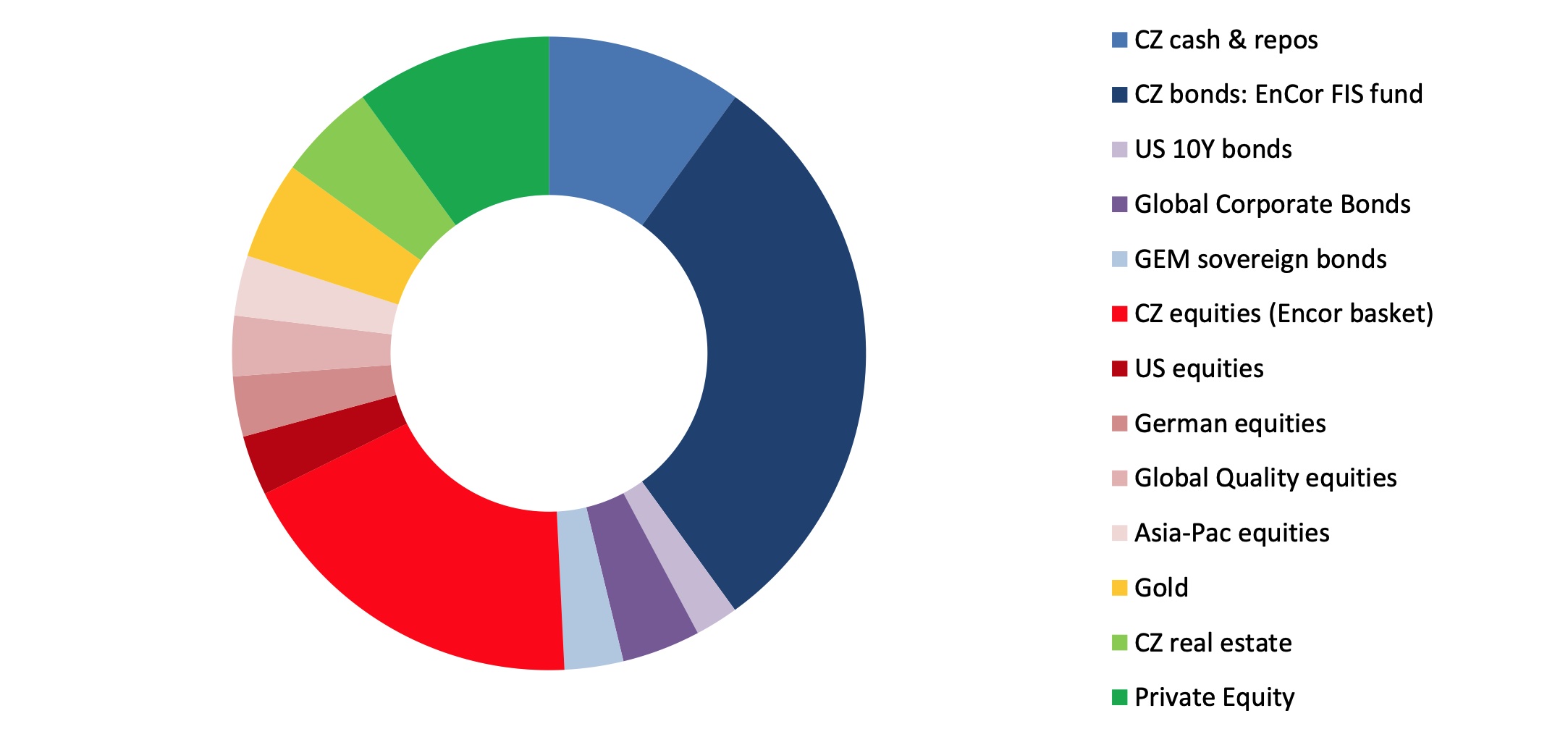
Allocation for a typical moderate risk client into Q4 2024*

Source: EnCor Wealth Management proprietary asset allocation model.
See disclosures at the bottom of this text.                                                  * Weights as of beginning of November.


Allocation for Q4 2024 of our “Rustovy” Dynamic OPF*

Source: EnCor Wealth Management proprietary asset allocation model.
See disclosures at the bottom of this text.                                                  * Weights as of beginning of November.

Our allocations imply a clear step towards a higher weighting in US markets, assigning around 70% of the total Equities pie to the world’s largest bourse.  That proportion matches the current weight of the US in the MSCI World Index, the most widely-followed equity benchmark globally. Our model selects to spread this via investing in US Small Cap stocks, remaining exposed to the US Tech sector, both via very diversified ETFs and by taking a larger position in an ETF tracking the ubiquitous US S&P 500 Index. We retain weightings in Czech equities and in high dividend-paying Global “Quality”  stocks in our Dynamic mandates.

Behind this re-weighting towards the US are signals that economic growth and liquidity in the world’s largest economy remain healthy. A “pro-business” Trump Presidency is likely to seek continuation of the US’s very low-tax regime and very high fiscal deficits that have primed economic growth in the last 2 years. The recent rate cuts by the US Federal Reserve (-75 basis points in 2 months) are likely to support economic activity into 2025. While many will worry about the resurgence of inflation due to the possible imposition by the US of tariffs on imports, especially from China, the possible deportation from America of (illegal) workers and that wide fiscal deficit, these concerns are not going to crystallize into reality before the President Trump’s second Inauguration on 20 January 2025.

The natural “hedge” in our portfolios to the above positioning in the US market and its accompanying risks are the remaining weightings in Czech koruna cash, Czech bonds and in precious metals, especially gold. These solid building blocks together make up nearly half of our Balanced (moderate-risk) mandates and close to 40% of our Dynamic portfolios, including the EnCor Rustovy OPF. Large allocations to Czech bonds and cash suppress portfolio currency volatility while gold offers investors a hedge on potential weakness in the US dollar, to policy-making in the BRICS countries, to geopolitical risk, to continued Central Bank-buying of precious metal reserves and to worries over “currency debasement” via inflation.

Our portfolios remain relatively balanced, overall, as a result of these allocations. International bonds, where our exposure is limited, do look somewhat fully-priced in Europe, after a strong rally in 2024 and under pressure in the US, as investors absorb those potential medium-term inflation risks of the Trump Administration’s likely set of policies. Weightings in industrial commodities are now zero, while those in Asian and European equities are also zero or very limited in our Dynamic mandates. This overall balanced approach looks appropriate, especially after such strong returns so far in 2024.

Disclaimer: This article does not constitute an investment advice, or a recommendation to buy or sell a specific security. Please contact us at welcome@encorwealth.com if you would like to consult on your individual situation.

Author:  Mark Robinson

EnCor Navigator: allocation of assets in Q3 2024

Inflation’s slow comeback

Commentators and investors who have “missed out” on gold and Equities in many places rising to all-time highs in recent months have struggled with the idea that the world economy is actually growing (and “inflating”) somewhat faster than many envisaged when 2024 started. Fortunately for us, our proprietary EnCor Asset Management Asset Allocation model, created by Mark Robinson, captured some of this momentum by maintaining full weights in various Equity assets and in precious metals during the first half of 2024. As a result, we delivered a record Q1 for clients and followed it up with continued firm performance in Q2. Our moderate-risk mandates rose around 7.1% in CZK terms in H1 2024, while our new “Rustovy OPF” (“Growth Open-Ended Fund”) which has a “Dynamic” focus returned B-Class unit-holders 8.7% year-to-date in CZK net-of-fees up to the end of July.


Allocation for a typical moderate risk client into Q3 2024*

Source: EnCor Wealth Management proprietary asset allocation model.
See disclosures at the bottom of this text.                                                  * Weights as of end July.


Allocation for Q3 of our “Rustovy” Dynamic OPF – Q3 2024*

Source: EnCor Wealth Management proprietary asset allocation model.

See disclosures at the bottom of this text.                                                  * Weights as of end July.


So what’s next? For this third quarter, our asset allocation model reduces overall exposure to Equities marginally, thus booking some profits. The money goes back into precious metals (more gold and silver) and rotating into inflation-linked bonds within Fixed Income. These moves and the retention of weightings in “Global Quality”, German Equities and in India and copper for our “Rustovy” unit-holders are market “hedges” on higher inflation readings coming out in H2 2024.

Inflation rates have fallen significantly since the large spike in general consumer prices globally in 2022. Food and energy prices in particular have helped bring headline consumer price inflation (“CPI”) levels back, in many cases around the world to the 2%-3.5% range, just above Central Bank targets (generally set at 2%). But a mixture of factors, including moderately more expensive energy, economies with low unemployment rates and some governments, especially the GDP-heavyweight US Biden-Harris Administration, are still spending much more than they gather in taxes. This is inflationary. And if the make-up of the US Congress after November is so inclined, this process may continue.

Part of the symptom of a higher trend inflation rate is strong GDP growth. And this links into our model’s almost full positioning in Equities. But at the same time we are not “overweight” in shares. Our positions in Bonds overall and Gold are also full. And after all, cash returns in koruna still amount to around 4% annualised.

As we have seen in August and now into September, markets are going through some choppy weeks. A broader correction in “risky assets” might or might not develop. US election uncertainty, war & geopolitics and some tension in markets over the likely speed of US Federal Reserve interest rate cuts plus the added factor of the Bank of Japan embarking on interest rate rises after decades at zero-bound rates can all affect market sentiment. A more balanced approach looks appropriate, especially after such strong returns so far in 2024.

Disclaimer: This article does not constitute an investment advice, or a recommendation to buy or sell a specific security. Please contact us at welcome@encorwealth.com if you would like to consult on your individual situation.

Author:  Mark Robinson

EnCor Navigator: allocation of assets in Q1 2024

“Goldilocks” for now

As in the famous “Goldilocks” fairy tale, investors in recent months have seen inflation tracking down to moderate levels both in G10 countries and in the Czech Republic as perfect for risk-taking. That inflation is “not-too-hot, not-too-cold” has sent equity markets to all-time highs in the US, in Europe and also in Japan. In this environment, our proprietary EnCor Asset Management Asset Allocation model, created by Mark Robinson, adopts a balanced outlook. Returns in safer koruna cash and bonds are still high but falling. Allocations to a spread of USD-denominated bond and equity asset classes are increased this quarter.

Allocation for a typical moderate risk client into Q1 2024*

Source: EnCor Wealth Management proprietary asset allocation model.

See disclosures at the bottom of this text.                                                  * Weights as of end January.


For this quarter, our asset allocation model reduces overall exposure to CZK-denominated assets to 52% in Q1 2024, down from 65% in Q4 for a typical moderate risk client. Cash yields in the Czech Republic are now well below 6%, as the CNB has embarked on its rate-cutting cycle. This reduces the koruna “risk-free rate of investing” or the “cost of capital” in our model, rendering the likely returns from other asset classes more attractive by comparison. Accordingly, our strategy advocates to invest in a blend of USD-denominated equities and bonds this quarter. Thus, we add in our client portfolios to positions in the dominant US market, specifically also to US Tech stocks and to global “high-quality” companies, (those with high returns on invested capital) and also Asia-Pacific shares. Our model sells down positions in strongly-performing German equities and UK Small Cap stocks. Our strategy also re-enters international bonds, with exposure both to benchmark 10-year Treasuries, yielding over 4% in USD presently and a position in inflation-linked bonds, which allows some protection against any revival in inflationary pressures.

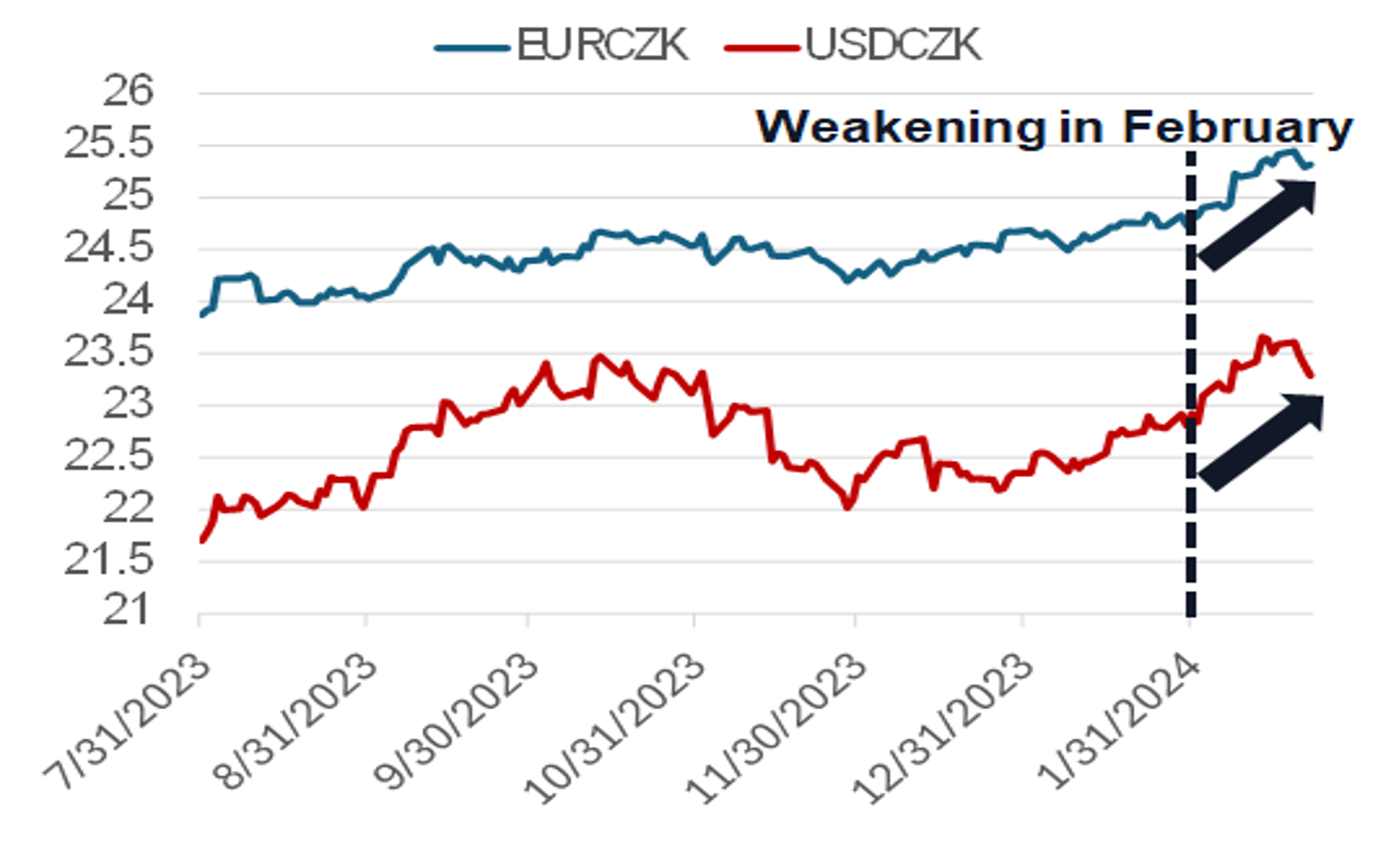
At the time of writing, in late February, the koruna has already weakened some -2% versus the USD and the EUR. Investors are pricing in the reality of lower interest rates and very insipid Czech GDP growth. The currency’s move has delivered positive returns on international assets for koruna-denominated investors.

CZK exchange rate vs. EUR and USD

Source: investing.com, EnCor Wealth Management

How much lower the koruna will go is a question to assess, given the potential for imported inflation that the weaker currency would bring. Members of the CNB’s Monetary Policy Committee are alert to this risk and have sought, after cutting policy rates, to emphasise that future monetary easing might have to be slower than markets expect. This should keep returns from Czech corporate bonds elevated in the 6%-8% range for now. Our model advocates a full weighting there.

Globally, 2023’s resilience of the US economy, with real GDP expanding at a 3.3% annual rate in Q4, surprised many commentators. Adding in inflation of around 3%-4% means nominal growth of around 6%-7%, which is a reasonably solid base, for now, for earnings growth. The US economy is slowing, thus presenting a risk but part of the “Goldilocks” scenario for markets certainly for H1 2024 is that the incumbent Democrats have no interest in seeing recessionary conditions unfold ahead of the Presidential election in November 2024. Thus, the Administration continues to run a huge fiscal deficit (perhaps -5-6% of GDP), priming growth and inflation. Equities are therefore likely to “grind higher” for now and dollar government bond yields will likely sustain over 4%. US investors expecting interest rate cuts may be disappointed in H1 2024. Our model’s allocation to gold will increasingly come into play in coming months as investors start to grapple with the question of US (and other G10 countries’) budget deficits, fiscal stability and inflationary effects. Gold will also act as a hedge in the event that the US economy does falter and/or if the current fragile geo-political situation worsens.

So, for this quarter, our overall “barbell strategy” remains in place. We retain solid CZK cash and bond positions but increase allocations to USD bonds, equities and hold gold. Markets remain in a “Goldilocks” phase and some positive returns are probable in the near term.

Disclaimer: This article does not constitute an investment advice, or a recommendation to buy or sell a specific security. Please contact us at welcome@encorwealth.com if you would like to consult on your individual situation.

Author:  Mark Robinson

EnCor Navigator: allocation of assets in Q4 2023

Cutting risky assets into stronger markets

US and global equities spent most of 2023 in a rally phase, though performance was extremely concentrated among the “magnificent 7” giant US Tech stocks. This narrowing of the participants in the US’s rally is often a precursor of more difficult times ahead. As we approach the 2023 year end, our proprietary EnCor Asset Management Asset Allocation model, created by Mark Robinson, cuts positions in equities, favouring lower-risk CZK cash and bonds and increased positions in precious metals.

Allocation for a typical moderate risk client into Q4 2023*

Source: EnCor Wealth Management proprietary asset allocation model.

See disclosures at the bottom of this text.                                                  * Weights as of 31 October.


For this quarter, our asset allocation model trims the overall position in equities through selling positions in the dominant US market, global “high-quality” companies, (those with high returns on invested capital) and also Czech shares. Weightings in CZK-denominated cash and repos are increased. The latter still yield over 6%+ per annum while safer CZ bonds are still offering 7.5%-9% annual returns. We continue to avoid international bonds, as major economy government budget spending and inflation risks are still very apparent. US dollar weakness is apparent and is likely to continue, reducing koruna-terms returns from these assets. Our model raises overall exposure to CZK-denominated assets again, up to 65% in Q4 from 49% and 59% in Q2 and Q3, for a typical moderate risk client. Our model thus seeks, for the short-term, to reduce price volatility risk by holding assets with certain or near-certain returns in koruna terms.

A major trigger of the downward shift in our weightings in equities is the deterioration in leading indicators of economic growth. While certain economies, such as Germany and the Czech Republic have flirted with recession, with prints of zero or negative real GDP growth during 2023, the resilience of the US economy, with real GDP expanding at close to a 5% annual rate in Q3, surprised many commentators. Our model suggests this is “in the price” of US equities and that forward-looking data is pointing to a much more subdued picture in 2024. A recession is distinctly possible in the world’s largest economy next year.

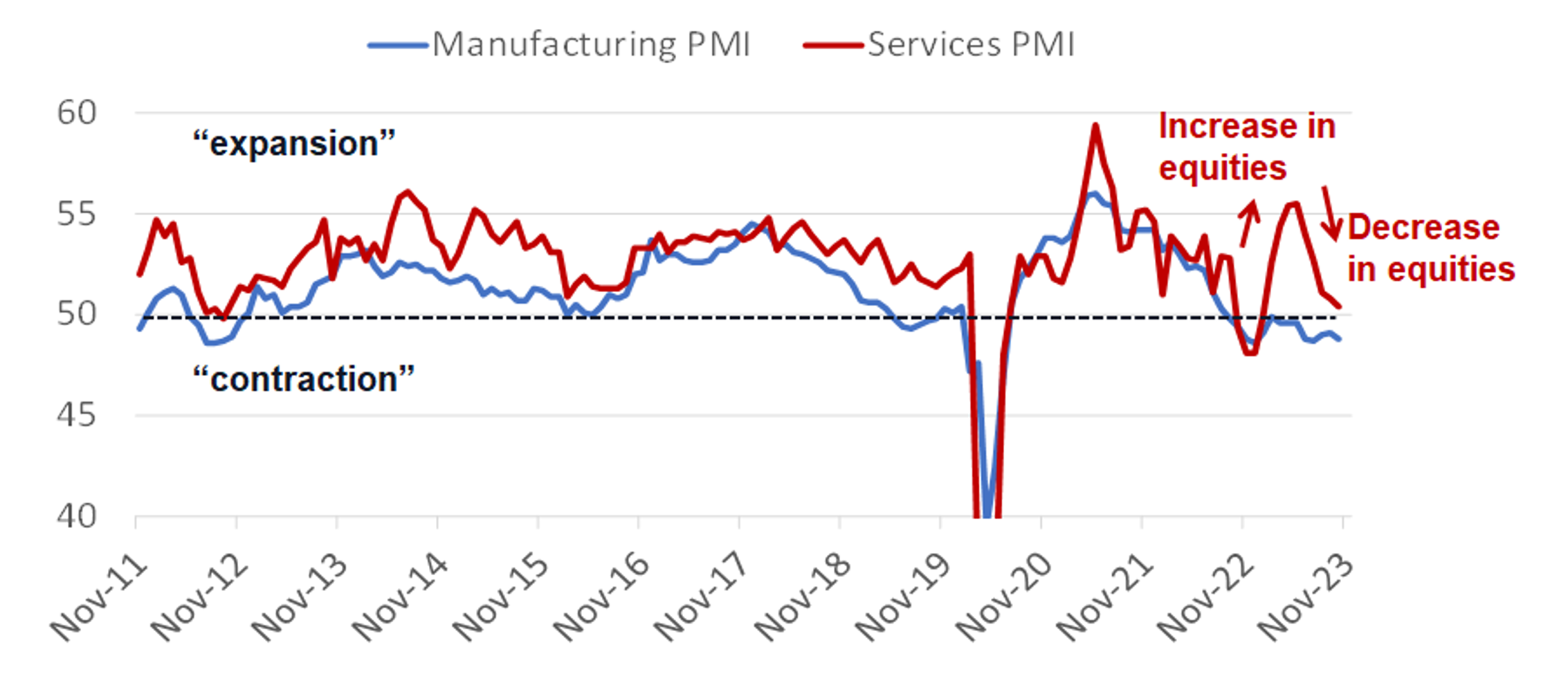
JP Morgan Global Manufacturing and Services PMI indices*

Source: IHS Markit, investing.com, EnCor Wealth Management                              * monthly data, 50 level = “neutral”

Two of the key leading indicators that our allocation model tracks are among those that are signaling us to reduce equity weightings and pointing towards weak GDP growth in key markets in 2024. Every month in both Developed and Emerging Market economies, information services provider IHS Markit and investment bank JP Morgan collect and collate purchasing manager indices (“PMIs”), asking company managers about prospects for their businesses. These indices are published at the beginning of every month, with 50 as a neutral level. Globally, the Manufacturing PMI Index is consolidating just below 50 but it is the sharp deterioration of the Services PMI that is partly triggering our more cautious positioning in equities. Other leading indicators, such as the US government’s collection of tax receipts are also falling rapidly. If a recession in the US comes in 2024, it is likely to be quite mild.

So, for this quarter, the emphasis is on preservation of returns through larger positions in CZ cash and bonds. The model also chooses to increase the position in precious metals with gold and silver featuring in both our moderate and high-risk strategies. Precious metals tend to be uncorrelated with other assets, provide protection against economic slowdowns, historically were inflation hedges and have always been seen as protection against the “debasement,” or increase in the supply, of paper “fiat” currencies. Gold also appears to be very under-owned by many conventional equity-bond and multi-asset funds despite trading very close to all-time highs presently.

Disclaimer: This article does not constitute an investment advice, or a recommendation to buy or sell a specific security. Please contact us at welcome@encorwealth.com if you would like to consult on your individual situation.

Author:  Mark Robinson

Go to Top